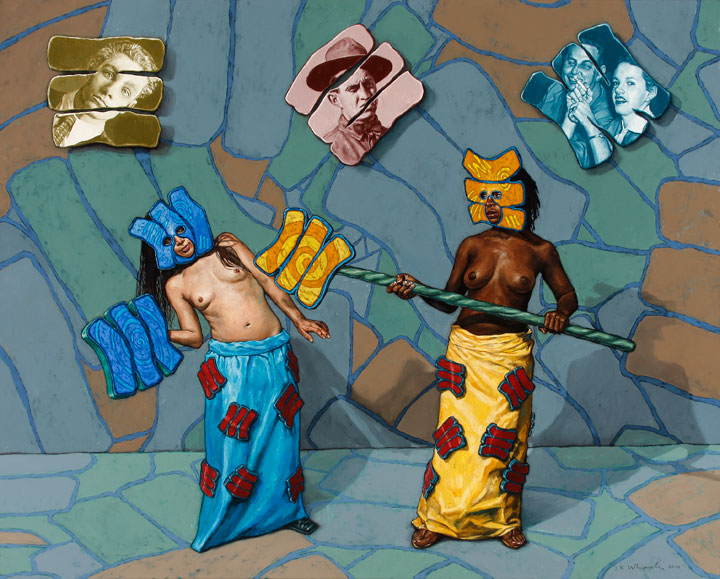
"The Ambivalent Genesis of Being," oil on canvas, 40" x 50", 2010
| ARTIST’S STATEMENT by Jeff Whipple |
|
My artwork has always been fused with my philosophy of living, which is to register, chronicle and respond to life. I use images and words to engage viewers in imaginative contemplations about the weirdness and beauty of our brief appearance in the infinity of time. The media includes drawing, painting, sculpture, photography, video, performance, installation and playwriting.
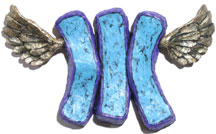
All of my visual art has a three-line motif that I created in the early 1980s to make my compositions appear planned and organized. I use three lines because three repetitions of an element is a recognizable pattern and that implies a definite design.
In my recent work, the three-lines have evolved beyond a design element to become part of my subject matter. I use it as a symbol for life, life styles or life spans. If viewers understand that the symbol represents something about life then they will create their own ideas about what it means. I guide viewers toward a theme but leave it open-ended so they can creatively apply their own ideas to it.
I also use the three-line motif as a logo for my art. It’s an ironic commentary on corporate branding and product marketing. As another type of corporate branding comment I made the symbol into a cartoon character and it is being developed into a graphic novel and animation. I’m also using it as a type of political or governmental insignia and exploring where that can go in uniforms. |